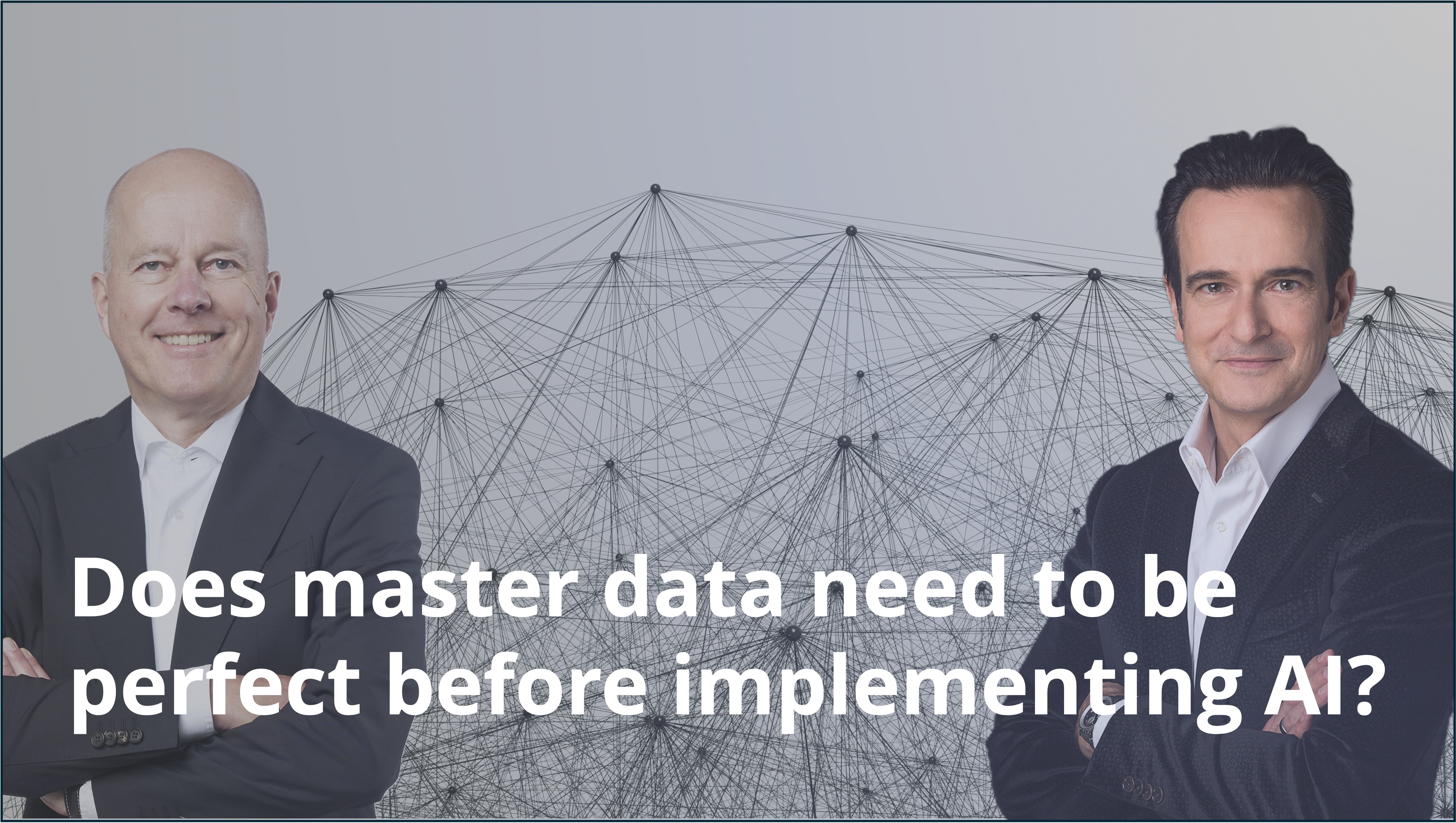
Does Master Data Need to be Perfect Before Implementing AI?
Andreas Müller and Stephan Gotthardt discuss what data planning systems really need and how AI agents can improve data quality during day-to-day operations.
Many companies face the same situation: They want to introduce a new planning system or AI application, but are told that their master data must first be completely cleaned up. What was supposed to be the start of a new project quickly turns into a lengthy preparation phase.
But is a perfect data foundation really necessary before a company can get started? Or can AI agents help review and gradually improve master data during ongoing operations?
Andreas Müller, founder of Recall Space, and Stephan Gotthardt, who has supported planning projects in the process and pharmaceutical industries for many years, discuss these questions. They agree that companies should not wait for perfect data. However, they have different perspectives on which information must be reliable from the beginning and how quickly companies can realistically adopt new technological capabilities.
Is Perfect Data a Prerequisite?
Andreas: In many projects, we hear the same statement: “We need to get our master data in order before we can introduce the new system.” That sounds reasonable at first. In practice, however, it can prevent companies from getting started at all. The data cleanup has a clear start date, but often no clear end date.
I therefore do not believe that a fully cleaned data foundation should always be a separate preliminary project. AI agents can operate within day-to-day processes and continuously review data. For example, they can compare order confirmations, prices, delivery dates and supplier information with the existing system data. Every detected deviation provides an indication of where information is missing or no longer accurate.
At Recall Space, this is exactly the approach we pursue with Lisa AI. Master data can be improved step by step as part of daily operations instead of through a lengthy preliminary project that must be completed before the actual implementation can begin.
Stephan: I agree that companies should not wait for perfect master data. However, we need to distinguish between two statements. “We can start even though the data is not yet perfect” does not mean that reliable data is no longer important.
A traditional planning system calculates its results based on clearly defined inputs. If a replenishment lead time is recorded incorrectly, the resulting plan cannot be accurate either. Certain information must therefore be available in sufficient quality from the start.
Planning Systems and AI Agents Have Different Requirements
Andreas: That is the crucial difference for me. A traditional planning system requires fixed input values. An AI agent, by contrast, can also work with incomplete information. It can identify relationships, compare data from different sources, highlight uncertainty and initiate a review or request additional information when necessary.
It does not always have to work with a single fixed value. Instead of using “16 days replenishment lead time,” it could work with a range such as “usually 21 days, but significantly longer in exceptional cases.” It can then refine this assessment with each new delivery.
This does not mean that the agent should simply guess. It means that a company does not need a supposedly perfect value for every piece of information from the very beginning.
Consider the replenishment lead time for a material. The system may show 15 days, while the responsible planner knows from experience that this supplier usually needs 20. This knowledge often exists only in that person’s mind or in a separate Excel spreadsheet. An AI agent can identify and make these deviations visible during ongoing operations.
Stephan: This is already part of planners’ everyday work. People use previous orders and similar materials to estimate what is likely to happen. AI does not reinvent this approach. However, it can make it more systematic and help ensure that relevant experience does not remain with individual employees.
At the same time, uncertainty must remain transparent. Historical data may show that a delivery usually arrives after 21 days. That is still no guarantee that the next delivery will do the same.
Historical Data Provides a Starting Point
Andreas: Many companies already have large volumes of historical transaction data. This data documents, for example, when something was ordered, confirmed and actually delivered. It can be used to derive realistic starting values.
Historical data does not provide an absolute truth. It provides the best currently available estimate. Ongoing operations then test this estimate repeatedly. If actual deliveries regularly differ from the values stored in the system, this indicates that a correction or closer investigation is required.
Stephan: However, we should not overestimate the quality of historical data. If goods receipts were not recorded immediately but entered collectively on specific days of the week, the calculated replenishment lead time may be incorrect. A statistically calculated value can appear reliable even though the underlying entries do not accurately reflect what happened in reality.
Andreas: That is exactly why historical and current data should always be considered together. Historical data provides an initial assumption. Current transactions show whether that assumption holds. If the two differ significantly, this should not be treated as a problem to hide. It is a valuable indication of a potential issue in the data or the underlying process.
Where Automation Needs Clear Boundaries
Stephan: Particularly in regulated industries, there are fields in which a system must not make assumptions or changes independently. An AI agent can make mistakes. Companies must therefore clearly define which information can be processed automatically and where controlled approval is required.
Andreas: That boundary is important. GMP stands for Good Manufacturing Practice and refers to binding requirements for the quality and safety of manufacturing processes, particularly in the pharmaceutical industry. Data changes that may affect quality, production or compliance must continue to be reviewed and approved in a controlled manner.
An AI agent does not replace these rules. However, it can identify deviations, prepare relevant information and initiate a review. In these cases, the responsible person continues to make the decision.
At the same time, many types of planning data do not directly affect this regulated core. These may include replenishment lead times, delivery calendars, lot sizes or observed supplier behaviour. Companies can often move more quickly in these areas.
Technical Feasibility Is Not Enough
Stephan: My most important concern is not purely technical. There is often a significant gap between what is technically possible and what companies are organisationally prepared to implement.
For many years, the prevailing message was that better planning required a large central system and that the data had to be correct before that system could work. Suddenly claiming that AI can solve many of these problems can overwhelm organisations. Companies do not just have to introduce new technology. They also need to build trust, clarify responsibilities and involve their employees.
Andreas: That is a valid point. People who work with AI systems every day can easily underestimate how far these technologies remain from the daily working reality of many employees. At the same time, I often see companies underestimate their employees’ capabilities. Planners think analytically, recognise patterns and already make decisions based on incomplete information.
The issue is often not a lack of ability, but a lack of access to suitable tools. Companies therefore need to invest not only in technology, but also in secure access, understandable processes and the necessary skills.
Initial Cleanup and Continuous Improvement
Stephan: For me, the realistic solution lies between the two extremes. Companies should clean up their data sufficiently to become operational. This requires a focused initial cleanup. However, the project should not remain on hold until every individual record is perfect.
The data should then be reviewed and improved continuously during ongoing operations. Data quality is no longer treated as a one-off major project, but as a permanent part of daily work.
Andreas: This is precisely where AI agents can make a significant contribution. They can compare data from historical orders, current transactions and existing systems. They can identify deviations, suggest corrections and initiate necessary reviews.
This also changes the role of employees. They spend less time on manual data maintenance and can focus more on evaluating exceptions and making decisions.
The Shared Conclusion
The discussion leads to three central conclusions.
First, companies should not wait for perfect master data. Sufficient initial data quality is necessary, but complete perfection is not a realistic starting point.
Second, companies must distinguish between the data a planning system needs reliably from the beginning, the information that can be derived from historical transactions and the insights that only emerge during ongoing operations.
Third, technology and organisational readiness must be considered together. Not everything that is technically possible can be implemented effectively straight away. Clear responsibilities, controlled approvals and employee involvement remain essential.
The important question is therefore no longer: “When will our master data finally be finished?” It is: “How can we establish a reliable starting point and then continuously improve our data during ongoing operations?”


